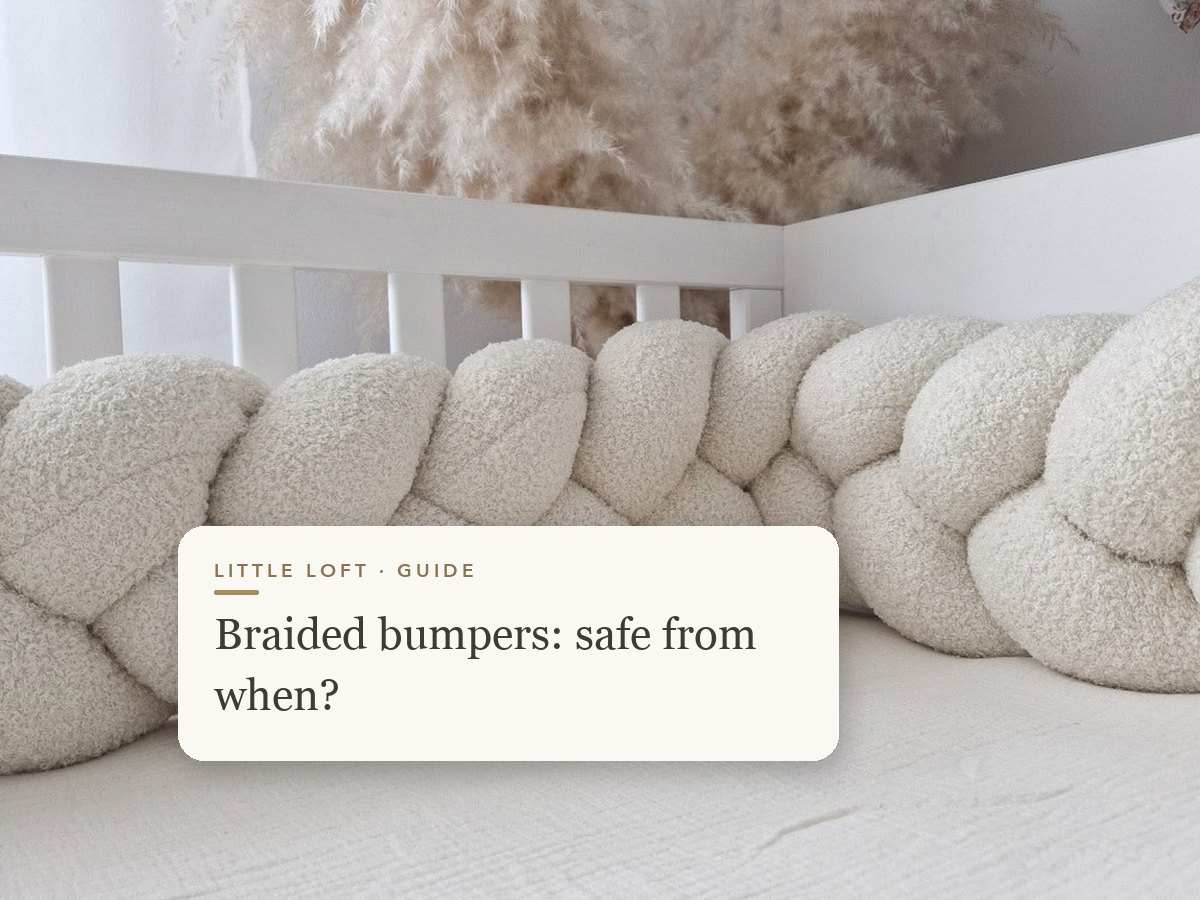
Are Braided Bumpers Safe? From What Age, and the Right Length
Are braided bumpers safe? Not in a baby's cot in the first year – but from around age 2 in a toddler bed or house bed. With an age guide, a length chart and a checklist for fixing one safely.
Are braided bumpers safe? In a baby’s cot, no: UK safer-sleep advice for the first 12 months is a clear cot, with no bumpers of any kind. A braided cot bumper starts to make sense from around age 2, in a toddler bed or house bed – as a soft cushion along the wall and at the head end, always tied on firmly. There is no official age limit after the first year, so what counts is what your child can already do.
In short
- 0–12 months: no braided bumper and no padded bumper in the bed your baby sleeps in. In the daytime, with you watching, it is fine as a play-area border.
- 1–2 years: better to wait. In a cot or cot bed the braid turns into a step for climbing.
- From around 2 years: yes, in a toddler bed or house bed – along the wall and the head end, tied on with every tie.
- Length for 90×200: 280 cm (one long side plus the head end) or 410 cm (one long side plus both ends).
- A braided bumper is a cushion and decoration – not a fall guard.
What is a braided bumper?
Braided bumper, bed braid, bed snake: the names differ, the idea is the same – a long, softly filled fabric roll along the edge of the bed. Plaited from three or five strands, it is taller than a single tube and keeps its shape better.
Our braided bumpers are braided by hand. The three-strand braid is about 15–17 cm high, the five-strand Wheat-Ear braid about 21–23 cm. Both are roughly 7–9 cm thick and have sewn-in ties.
Are braided bumpers safe – and from what age?
Not where your baby sleeps during the first year; after that it depends on the bed and on your child’s development. Our guide follows safer-sleep advice for babies and what parents tell us about everyday life.
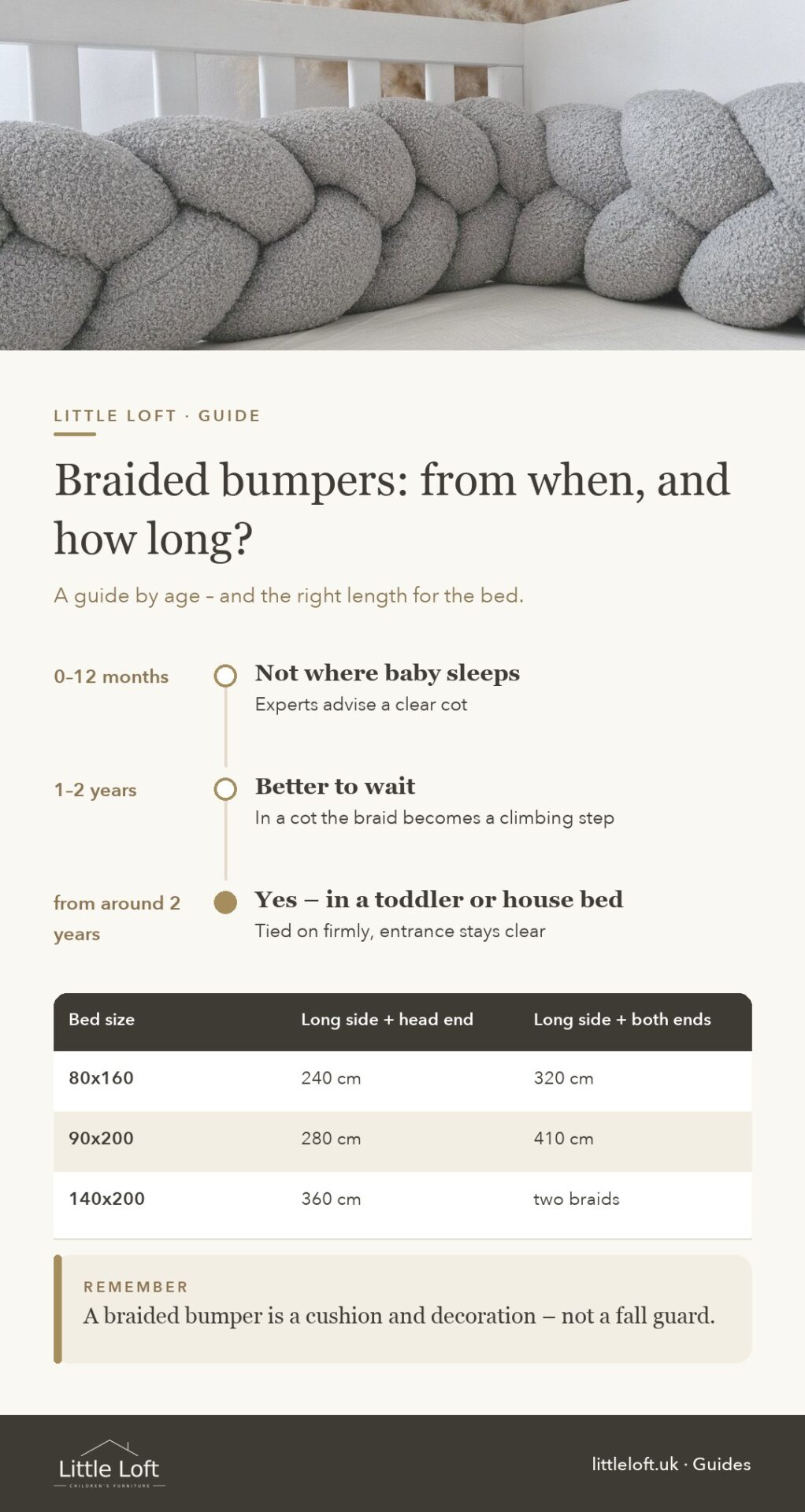
| Age | Braided bumper? | What matters |
|---|---|---|
| 0–12 months | No, not where baby sleeps | Experts advise a clear cot |
| 1–2 years | Better to wait | In a cot it is a climbing step |
| from around 2 years | Yes, in a toddler bed or house bed | Tied on firmly, entrance clear |
| top bunk | Best left off | The guard rail must stay clear |
Where does the 12-month line come from? The Lullaby Trust puts it plainly: “We do not recommend the use of any sort of cot bumpers”. The charity points to babies becoming entangled in the ties and material, or falling while pulling themselves up on a bumper. The NHS agrees in its safer-sleep advice for babies up to 12 months: keep the cot clear of anything that could cover your baby’s face and head – no pillows, duvets or cot bumpers.
For toddlers there is no comparable official rule. Our rule of thumb: a braided bumper fits once your child turns over freely in their sleep, sits up, pushes a cushion away without help – and no longer sleeps in a cot or cot bed. For most children that is around the second birthday.
Why does a braided bumper not belong in a baby’s cot in the first year?
A young baby cannot reliably turn away when their face rests against a soft cushion. Once babies roll and move about, the ties and fabric become a second concern. Hence the advice for the first year: a firm, flat mattress that fits – and nothing else in the cot.
Worrying about bumped heads is understandable – almost every mum and dad does. For safer-sleep experts, though, a clear cot matters more than a padded one.
Between 1 and 2 years, children pull themselves up and look for a foothold. A thick braid inside the cot is then a step – and the side much easier to get over.
What a braided bumper is still good for in the first year – with your baby awake and you watching:
- as a soft border around the play mat,
- as a cushion in front of a cold wall in the play corner,
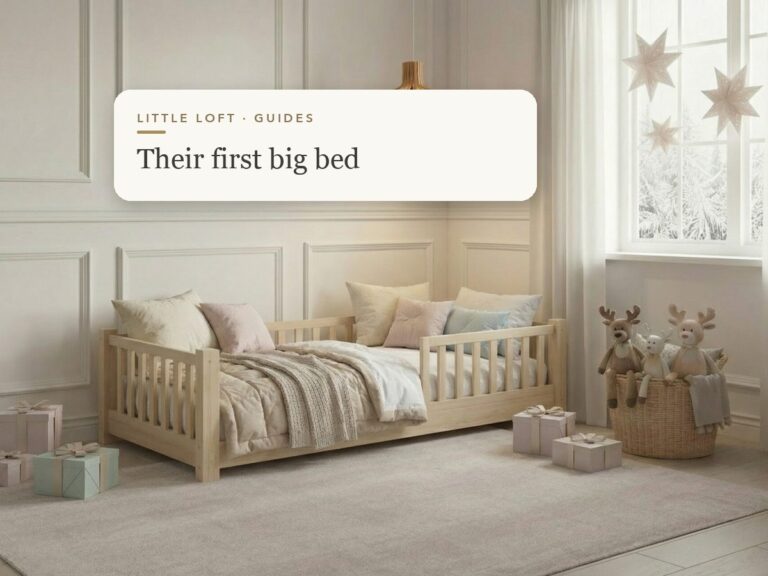
- as decoration in the nursery until the first “big” bed moves in.
For sleep, it comes out again. When a first bed makes sense is covered in our guide to a floor bed for a 1 year old.
Where does a braided bumper go on a toddler bed or house bed?
In a child’s bed the braid has one job: cushioning hard and cold spots. It need not run all the way round for that.
- Along the wall side: no cold wall, no knocks when turning over.
- At the head end: no bumps against the wood, and the pillow stays put.
- In front of the slats of the fall guard: arms and legs stay in the bed.
- The entrance stays clear: your child gets in and out without climbing over a cushion.
The braid takes up 7–9 cm of the sleeping surface on each side it covers. On a 90 cm wide single you will hardly notice it; on a narrow 70 cm toddler bed you will.
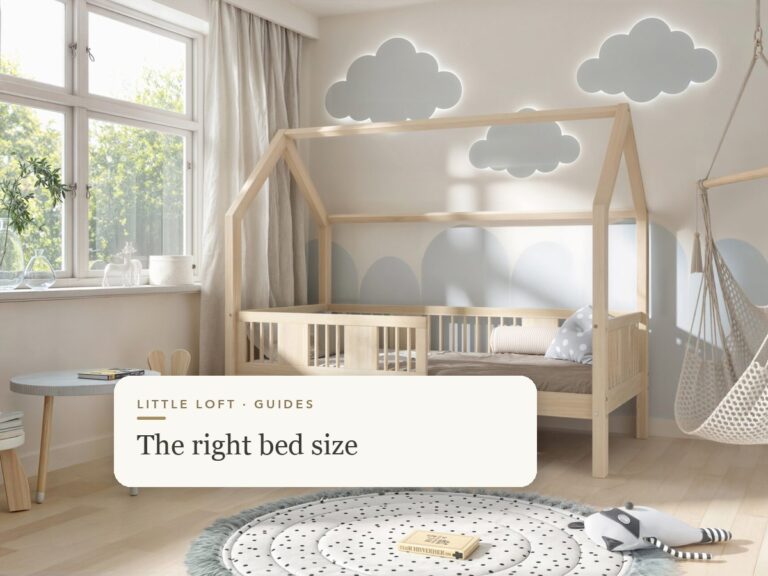
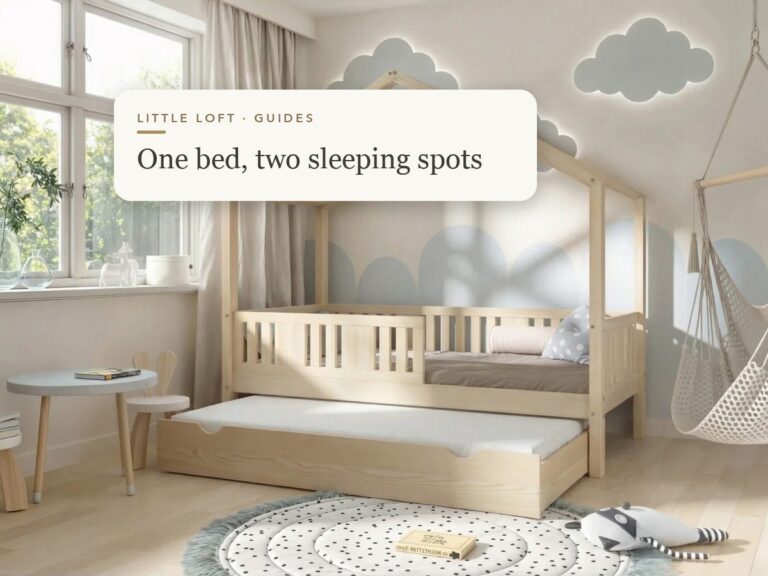
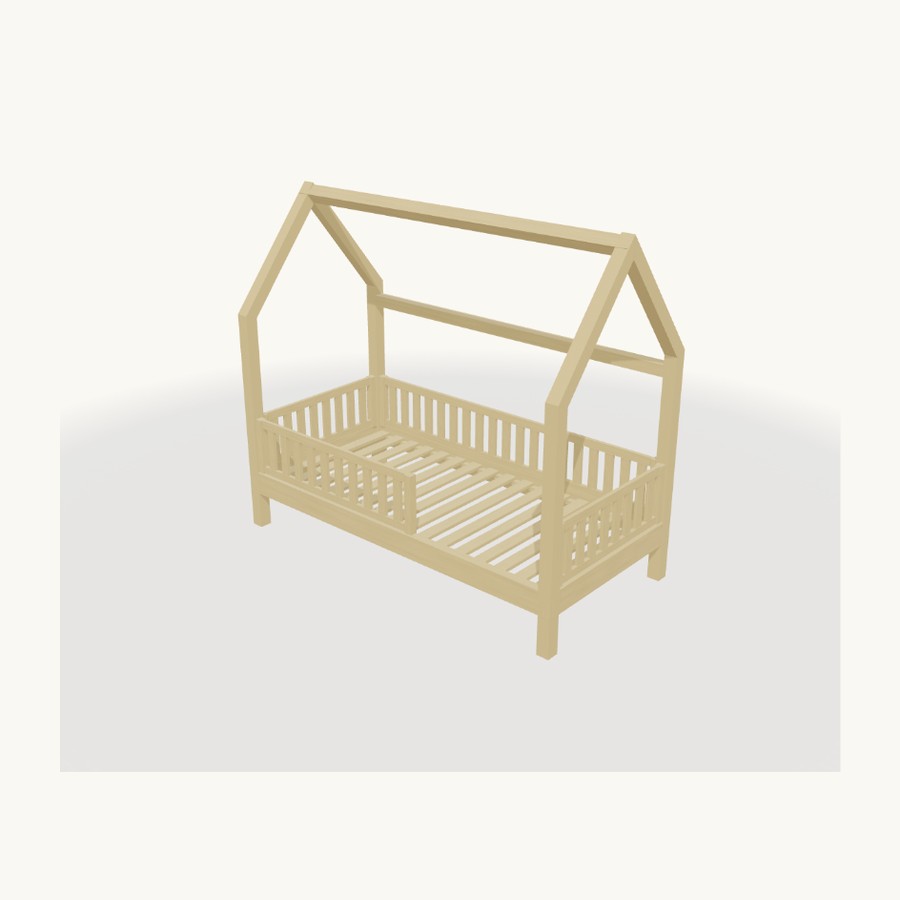
Important: a braided bumper does not keep a sleeping child in bed. That is the job of a fixed wooden fall guard – on our house beds in pine wood it can be fitted on the left or on the right. The braid suits low beds such as the LUMINA Mini children’s bed, where it makes the corner by the wall cosy.
Which length of braided bumper do you need?
Add up the sides you want to cushion and choose the same or the nearest length. Our braids come in seven lengths: 180, 210, 240, 280, 320, 360 and 410 cm. As they are braided by hand, the length can vary by around 5 %.
| Bed size (cm) | Long side + head end | Long side + both ends |
|---|---|---|
| 70×140 | 210 cm | 280 cm |
| 80×160 | 240 cm | 320 cm |
| 90×190 (UK single) / 90×200 | 280 cm | 410 cm |
| 120×200 | 320 cm | two braids |
| 140×200 | 360 cm | two braids |
A few centimetres short is no problem. Too long is less practical: the spare end lies loose in the bed. Torn between two lengths? Measure the inner edges of your bed, not the mattress.
How do you fix a braided bumper safely?
A loose braid shifts during the night and ends up on your child or on the floor. This is how it stays put:
- Use every tie. Fasten each one to a slat or the frame and knot it twice.
- Keep the ends short. No long loops or dangling tie ends in the bed – lead them outside or shorten them.
- Rest the braid on the mattress. Leave no gap for an arm or a leg to slip into.
- Check once a week. Knots tight, seams intact? Tie it on again after every wash.
- Never as a step. Leave it off in a cot with bars and on the top of a bunk or loft bed. Children only sleep up there from 6 years, and the guard rail must stay clear over its full height.
If in doubt, leave it out
Is your child a very restless sleeper, fond of burrowing under pillows and covers, or ill with a temperature? Take the braid out for those nights.
Cotton, velvet, waffle piqué or bouclé – which fabric suits you?
All our braids are filled with anti-allergenic silicone balls. The difference is in the cover:
- Cotton (140 g/m²): smooth, cool and hard-wearing, like the Braided Bumper Cotton in beige.
- Velvet (320 g/m²): dense and very soft – also as the tall Wheat-Ear braid with five strands.
- Waffle piqué: finely textured, in the widest choice of colours.
- Bouclé: fluffy and homely, such as the Braided Bumper Bouclé in cream.
The cotton and velvet cover fabrics are certified to OEKO-TEX® STANDARD 100. Wash at 30 °C on a delicate cycle, spin at no more than 800 rpm, reshape and dry flat – not in the tumble dryer.
Which mistakes are most common with braided bumpers?
- The braid is already in the newborn’s cot. Lovely to look at, but not for where a baby sleeps.
- It is meant to replace the fall guard. A soft cushion 15–23 cm high will not stop a child who rolls.
- It lies loose in the bed. Without knotted ties it wanders – in the worst case over the face.
- It runs all the way round, across the entrance too. Then your child has to climb over it.
- The length was guessed instead of measured. An extra 30 cm ends up as a loose end in the bed.
The bottom line: decoration in the first year, a cosy cushion from around 2
In a baby’s cot, the first year stays clear – that is what the Lullaby Trust and the NHS advise. With the move to a toddler bed or house bed, the braided bumper becomes what parents hope for: a soft edge that turns the bed into a den – tied on firmly, in the right length, with the entrance clear.
Is the big bed coming up? Our guide to a bed for a 2 year old explains what to look for. Or put your own bed together – model, size, colour and fall guard – and see it from every side in the 3D configurator.
Frequently asked questions about braided bumpers
From what age can a braided bumper go in the cot?
No braided bumper belongs in the cot during the first year. UK safer-sleep advice for babies up to 12 months is a clear cot with no bumpers, pillows, duvets or soft toys. Afterwards, in a cot with bars, the braid becomes a climbing step. From around age 2, in a toddler bed or house bed and tied on firmly, it makes sense.
Are braided cot bumpers safe for babies?
Not in the bed a baby sleeps in. The Lullaby Trust does not recommend any sort of cot bumper, braided ones included: babies can get tangled in the ties and fabric or use the bumper to pull themselves up. For toddlers from around 2 in their own bed, a braided bumper is fine when every tie is knotted and no loose loops hang into the bed.
Which length of braided bumper fits a 90×190 or 90×200 single bed?
For a UK single (90×190) or a European single (90×200), choose 280 cm if the braided bumper runs along one long side and the head end. For one long side plus both ends, choose 410 cm. Measure the inner edges of your bed to be sure – hand-braided bumpers can vary in length by around 5 %.
Does a braided bumper replace a fall guard?
No. A braided bumper is a soft cushion about 15 to 23 cm high, and it will not keep a child who turns over in their sleep in the bed. That takes a fixed wooden fall guard. The braid adds to it: it cushions the slats, keeps arms and legs in the bed and makes the wall side warmer.
How do you wash a braided bumper?
Our braided bumpers are washed at 30 °C on a delicate cycle, with a spin of no more than 800 revolutions per minute. Then pull the braid into shape and dry it flat. The tumble dryer and dry cleaning are not suitable. Afterwards, tie every tie on again and check knots and seams.
What can I use a braided bumper for in the first year?
In the daytime and with you watching, a braided bumper is useful in the first year too: as a soft border around the play mat, as a cushion in front of a cold wall in the play corner, or simply as decoration in the nursery. For sleep it comes out of the bed – until your child is around 2 and sleeps in a toddler bed or house bed.