Toddler Bed Size and Kids’ Bed Sizes by Age (UK Chart in cm)
Toddler bed size, cot bed, UK single or European single? A chart from 60x120 to 140x200 with mattress, bedding and room space – so you only buy once.
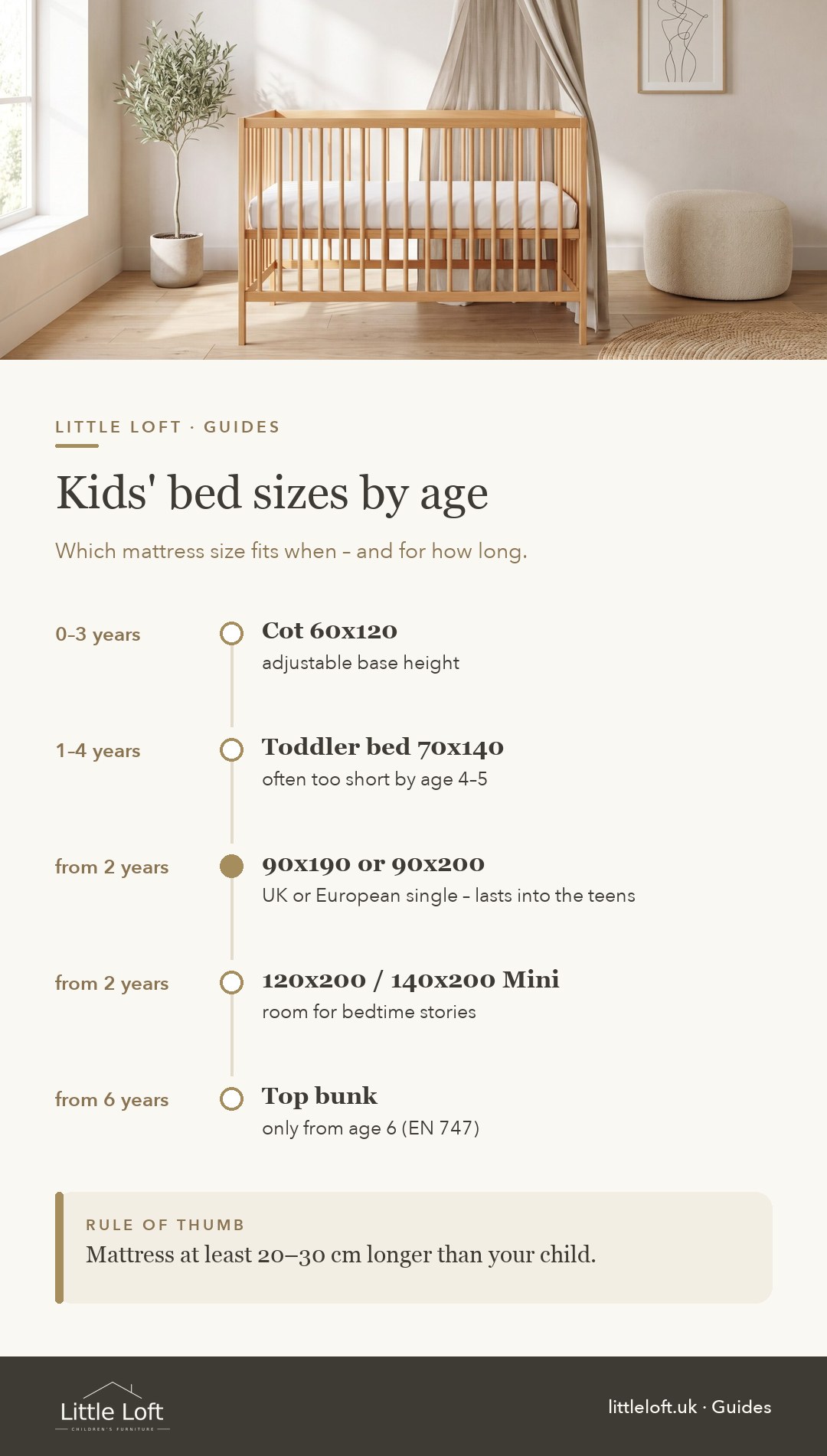
The standard toddler bed size in the UK is 70×140 cm – the same mattress as a cot bed. It fits from around 18 months, but many children outgrow it by four or five. To buy only once, go straight from the cot (60×120) to a single: 90×190 (UK single) or 90×200 (European single) – both last into the teens.
In short
- Rule of thumb: the mattress should be at least 20–30 cm longer than your child.
- 0–3 years: cot 60×120. From about age 2: a “big” bed.
- 70×140 is the UK toddler bed and cot bed size – but it is often too short by age 4 or 5.
- 90×190 is the UK single; 90×200 is the European single, 10 cm longer – and the most popular size at Little Loft.
- Bed size always means mattress size: a 90×200 bed takes a 90×200 mattress.
Kids’ bed sizes UK: what size bed for which age?
The chart shows when each size typically fits. Treat it as a guide: tall children need more length sooner.
| Bed size (cm) | Fits roughly | Good to know |
|---|---|---|
| 60×120 | 0–3 years | cot, adjustable base |
| 70×140 | 1–4 years | toddler bed / cot bed |
| 80×160 | 1.5–5 years | only if space is very tight |
| 80×180 / 90×180 | 2–8 years | in-between size |
| 75×190 | 3 years to teens | small single, narrow |
| 90×190 | 2 years to teens | UK single |
| 90×200 | 2 years to teens | European single, most popular |
| 120×200 | 2 years, for many years | wide, room for stories |
| 140×200 | from 2 years | from us only as a Mini at floor level |
A bed doesn’t get too small because your child gets older, but because they get taller. At around 5, many children are about 110 cm tall; at 10, about 140 cm. Add 20–30 cm and you see why a 160 cm bed gets tight in the school years and a 200 cm bed does not.
Cot 60×120: how long does it really last?
The 60×120 cot is the standard size for the first years. An adjustable base goes high for a newborn and right down once your child pulls themselves up. Our VERA cot takes a 60×120 mattress, has three base heights and, according to the product description, is designed for children up to about 3.
Length is rarely the problem – climbing is. Once your child swings a leg over the rails, it’s time for a low bed, often between the second and third birthday. Our guide Bed for 2 Year Old explains the signs.
Toddler bed size vs single: is a 70×140 bed worth it?
Many UK families buy a cot bed: a 70×140 cot that becomes a toddler bed once the sides come off. A separate toddler bed uses the same mattress. It suits a small child and a small room. The catch: by four or five, it is often too short – and you buy a second bed, mattress and bedding. That is why we don’t make 70×140 beds.
A small toddler bed size makes sense in three cases:
- The room really is small and every centimetre counts.
- It’s a second bed, for example at the grandparents’.
- You are planning a bunk bed or loft bed anyway once your child turns 6.
The small single (75×190) is another UK option: full length, 15 cm narrower. It suits box rooms, but there are fewer mattresses and sheets for it. Otherwise, a single is not “too big” for a toddler – with a fall guard, even a two-year-old feels snug in it.
What size bed for a 3 year old: UK single or European single?
Both singles last into the teenage years – the difference is 10 cm of length.
90×190 is the UK single. Mattresses and sheets are easy to find, and it helps when the bed must fit between door and wall. Our TEO Montessori bed, for example, comes only in 90×190 – with outer dimensions of 197 x 97 cm, it fits smaller bedrooms too.
90×200 is the European single. It gives 10 cm more length, so check that the mattress, fitted sheet and mattress protector are labelled 90×200 – a UK single sheet will be too short. It is the size families choose most often at Little Loft. With our house beds such as the LUMINA house bed, you choose between seven sizes from 80×160 to 120×200. All our beds are made from pine wood with a water-based finish.
120×200 and 140×200: when is a wide kids’ bed worth it?
A wide bed makes sense if you often lie down with your child or read stories at bedtime. 120×200 gives your child plenty of room and stays a comfortable bed well into the teens. Note that it is 10 cm longer than a UK small double (120×190), so you need a 120×200 mattress. The frames of our house beds take up to 190 kg – enough for a child and a parent.
140×200 is only available from us as a Mini version directly on the floor, for example the LUMINA Mini house bed. It is practical if a parent regularly sleeps alongside or two siblings like to cuddle up. Who this size is really for is covered in our guide Double Floor Bed for Kids.
How much space does the bed need in the bedroom?
Bed size is the sleeping surface, not the whole bed. The frame usually adds 7–10 cm to length and width – outer dimensions are on every product page.
- In front of the bed you need about 60–70 cm of free floor, to get in and out and make the bed.
- With a drawer bed, add the length of the drawer when it’s pulled out.
- With a house bed with a roof, height matters too – important under sloping ceilings.
Tip: mark the outer dimensions on the floor with masking tape. You will see straight away whether the door, wardrobe and play corner still have enough space.
Which mattress and bedding fit each bed size?
The mattress always matches the sleeping surface exactly: a 90×200 bed takes a 90×200 mattress. It should sit in the frame with no gaps, so your child’s arms and legs can’t get caught. A child’s bed needs a firm mattress – a soft adult mattress gives too much under a light body. For babies, The Lullaby Trust’s guidance on mattresses and bedding recommends a firm, flat mattress in good condition. You will find the right sizes among our children’s mattresses.
| Bed size | Mattress | Duvet |
|---|---|---|
| 60×120 | 60×120 | 100×135 or smaller |
| 80×160 – 90×190 | same as the bed | 100×135 |
| 90×200 – 140×200 | same as the bed | 140×200, pillow 50×70 |
A UK single duvet (135×200) also fits a 90×190 or 90×200 bed. Children’s duvet and pillow sets in these sizes are in our bedding range.
When is a child old enough for a bunk bed or loft bed?
For the top bunk, age matters more than size: only from age 6, as required by the European standard EN 747 for bunk beds and loft beds. Our bunk beds have standard sleeping surfaces too, and the exact measurements are on each product page. A younger sibling can sleep on the bottom bunk earlier. RoSPA’s advice on preventing accidents to children is a good checklist for the rest of the bedroom.
5 common mistakes when choosing a kids’ bed size
We hear these from parents again and again:
- Buying for today’s age instead of the next few years. Ask yourself: will it still fit at 8 or 10?
- Measuring only the sleeping surface. The frame, roof, drawer and the free space in front of the bed all need room too.
- Mixing up UK and European sizes. A 90×190 sheet won’t stretch over a 90×200 mattress. Check the size on every mattress, sheet and protector.
- Reusing an old mattress that doesn’t quite fit. A gap between mattress and frame is uncomfortable and can be dangerous.
- Moving to the top bunk too early. Even if the size fits: children sleep on top only from age 6.
Verdict: choose the right size once instead of buying twice
A 60×120 cot covers the first years. For the first big bed, a single lasts longest – 90×200 if you have the room, 90×190 if space is tight. If you like to lie down with your child, choose 120×200 or 140×200 at floor level. Add a firm, snug mattress and free space in front of the bed.
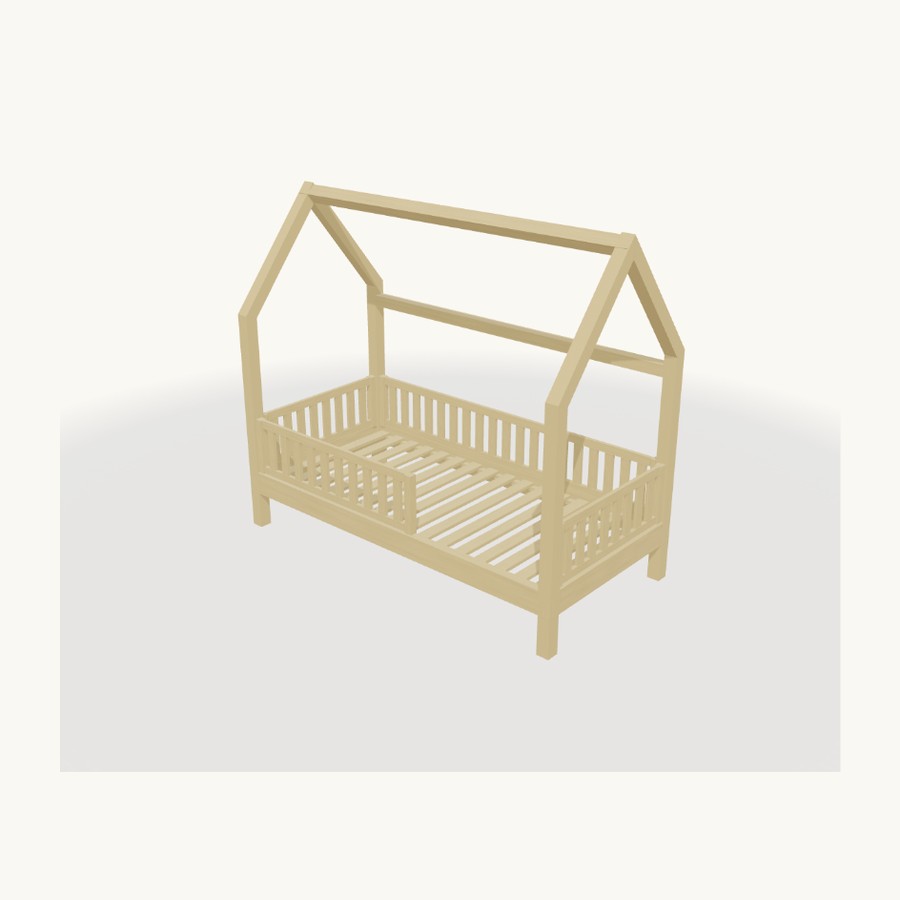
Not sure which size fits your child’s room? Our Bed Advisor helps in just a few questions. Or choose the size, colour, roof and fall guard yourself and see your bed from every side in the 3D configurator.
Frequently asked questions about toddler bed size
What size is a toddler bed in the UK?
The standard toddler bed size in the UK is 70×140 cm, the same as a cot bed mattress. A cot is usually 60×120 cm, a small single 75×190 cm and a UK single 90×190 cm. Many European beds, including ours, also come in 90×200 cm, the European single, which is 10 cm longer than a UK single.
What size bed for a 3 year old?
For a three-year-old, a single bed is the size that lasts longest: 90×190 (UK single) or 90×200 (European single). It is not too big for a toddler as long as it is low and has a fall guard. A 70×140 toddler bed also fits at three, but it is often too short by the age of four or five.
Toddler bed size vs single: which is better?
A 70×140 toddler bed is smaller and fits tight rooms, but your child will outgrow it within a few years. A single bed of 90×190 or 90×200 lasts into the teenage years, and mattresses and bedding are easy to find. If the room allows it, a single with a fall guard means you only buy once.
How long should a child’s bed be?
As a rule of thumb, the sleeping surface should be at least 20 to 30 cm longer than your child. Many children are around 110 cm tall at 5 and around 140 cm at 10. That is why a 160 cm bed gets tight in the school years, while a 190 or 200 cm bed lasts into the teens.
What mattress size do I need for a kids’ bed?
The mattress is exactly the size of the sleeping surface: a 90×200 bed takes a 90×200 mattress, an 80×160 bed an 80×160 mattress. It should sit in the frame with no gaps and be fairly firm for children. Don’t put a UK single mattress (90×190) into a European single bed – the 10 cm gap is unsafe.
What bedding fits a 90×200 European single bed?
A 90×200 bed needs a 90×200 fitted sheet, labelled European single – a UK single sheet is too short. On top, a 140×200 duvet with a 50×70 pillow fits, and a UK single duvet (135×200) works too. For smaller beds from 60×120 to 90×190, many families use a 100×135 children’s duvet with a 40×60 pillow.