Double Floor Bed for Kids: Who a 140×200 Bed Is Really For
Double floor bed or a standard single? When a wide 140x200 bed makes sense, how much room it takes and what UK parents need to know about sheet sizes.
A double floor bed is worth it mainly if you lie down with your child at bedtime, if your child is a restless sleeper or if siblings love to snuggle up together. For one child on their own, a 90×200 bed is plenty – and it takes up about one square metre less floor space. A wide floor bed is for children who have outgrown their cot, not for babies.
In short
- A 140×200 bed is ideal if mum or dad lies down at bedtime: two people fit comfortably side by side.
- For one child alone, 90×200 is enough – it’s the size families choose most often at Little Loft.
- 140×200 is the European double: 5 cm wider and 10 cm longer than a UK double (135×190), so buy sheets labelled 140×200.
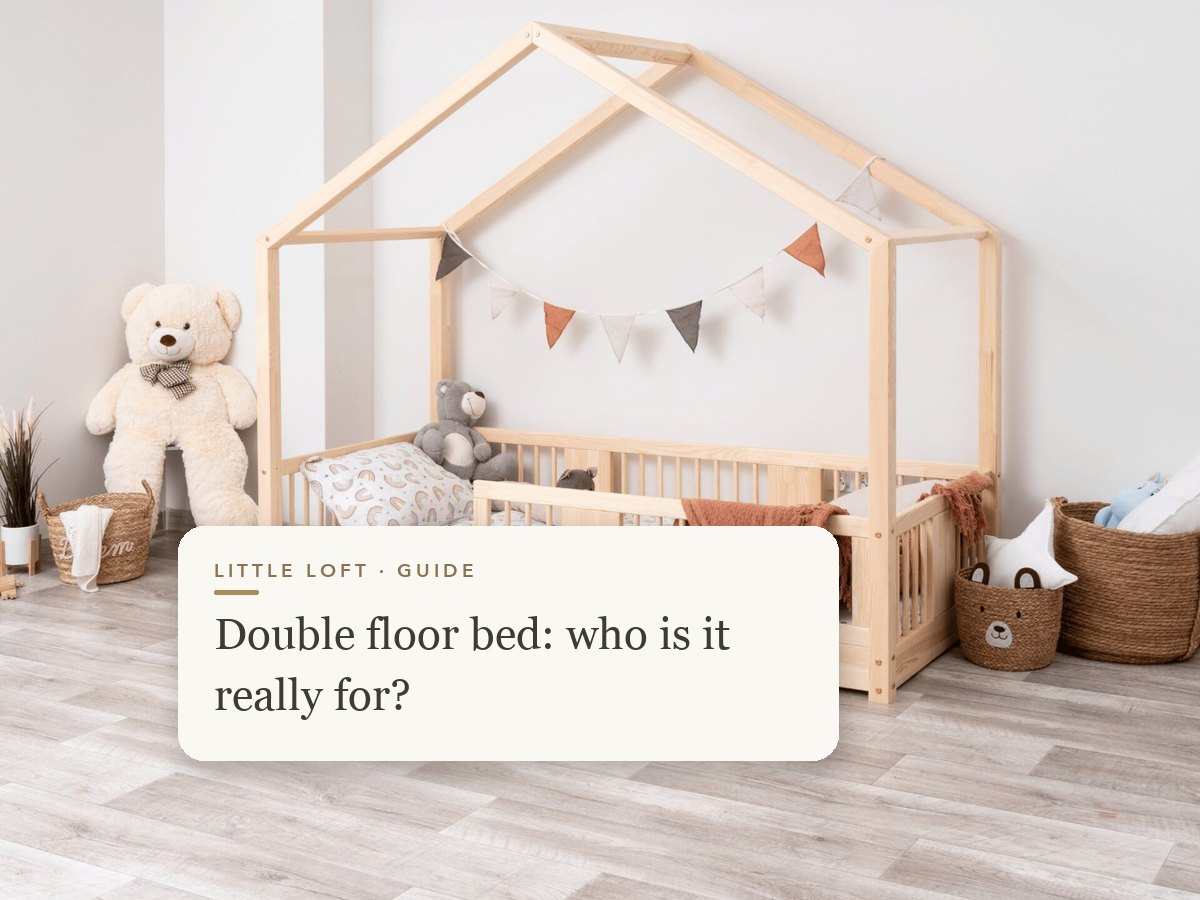
- At Little Loft, 140×200 comes only as a Mini bed sitting directly on the floor: no fall from height, and easy for you to lie down beside your child.
- For babies: a separate cot in your room.
When is a double floor bed worth it?
Choosing the width is really a question about your family’s evenings and nights. A wide bed isn’t a luxury if it solves a real problem. These are the situations parents mention to us most often:
- Lying down at bedtime: Many children drift off more easily when a parent lies down beside them. In a 90×200 bed you end up half hanging off the edge. In 140×200 you each get around 70 cm – enough to lie side by side without a struggle.
- Restless sleepers: Some children turn a full circle overnight and wake up lying sideways. More width means fewer wake-ups at the edge of the bed.
- Siblings and sleepovers: At weekends siblings often want to snuggle up, or a cousin stays the night. For two children who share a room every night, bunk beds or a bed with a pull-out trundle drawer are the better answer.
- Poorly nights: Fever, bad dreams, molars coming through – when you spend the night next to your child, you’ll be grateful for every centimetre.
- A bed for years to come: 140×200 is a full-size adult double. Your child won’t outgrow it.
If none of these apply to you, 90×200 is usually the more sensible choice: less floor space, cheaper bedding and more room to play.
90×200, 120×200 or 140×200: how do the sizes compare?
Our beds come in European sizes, which differ slightly from UK bed sizes. Between the classic children’s bed and the wide family format sits 120×200. The three sizes side by side:
| Size | Who fits | At Little Loft |
|---|---|---|
| 90×200 (European single) · 1.8 m² | one child, right into adulthood | all models, most popular size |
| 120×200 · 2.4 m² | one child with room to spread out, a parent for a quick story | many models, also with legs |
| 140×200 (European double) · 2.8 m² | child and parent at bedtime | Mini floor bed only |
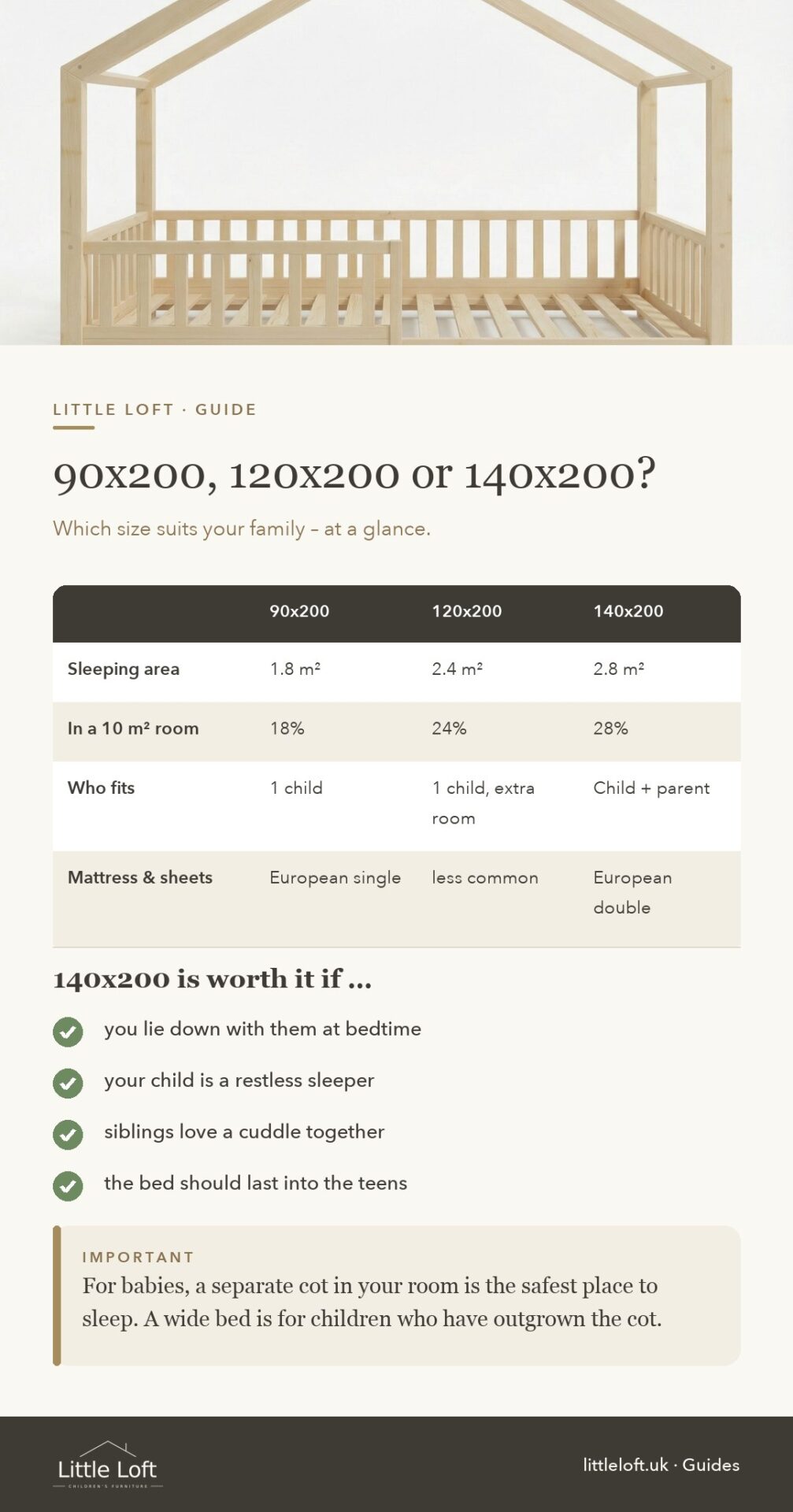
120×200 is as wide as a UK small double and a good compromise for a larger bedroom if you only sit down now and then for a story. For two people falling asleep together, though, it’s a squeeze. If you lie down with your child regularly, 140×200 is far more relaxed.
How much space does a 140×200 bed need?
The sleeping area alone measures 2.8 m². Add the frame and the safety rail – the exact outside dimensions are listed on every product page. An example for a typical children’s bedroom of 10 m² (about 108 sq ft):
- A 90×200 bed covers around 18% of the floor.
- A 140×200 bed covers around 28% – almost a third.
- In a small bedroom of around 7 m², a 140×200 bed alone takes up about 40% of the floor.
Leave at least 60 cm (about 2 ft) clear along the side where your child gets in and out. Before you buy, also measure the door, the wardrobe and the radiator. With a house bed, think about the height of the roof too: under a sloping ceiling, check the overall height on the product page.
In a room of about 12 m² or more, the wide bed hardly makes a difference. In a very small room, a 90×200 bed gives you back a lot of play space.
Why we only make 140×200 as a floor bed
Our 140×200 children’s beds come exclusively as a Mini version: the frame sits directly on the floor (0 cm). For such a wide bed, that has several advantages:
- Your child climbs in and out alone – very much in the Montessori spirit, with no ladder and no help.
- No fall from height, even if your child rolls to the open side in their sleep.
- Comfortable for parents: you can lie down without squeezing in and slip away quietly once your child is asleep.
- Strong enough for two: the reinforced slatted base of our Mini beds takes up to 190 kg – plenty for mum or dad to lie down for a bedtime story.
You’ll find the 140×200 size on Mini models such as the LUMINA Mini house bed, the ASTRIA Mini house bed and the LUNA Mini children’s bed. See every design in our house beds collection. The frame, the safety rail (it fits on the left or right) and a wooden roll-up slatted base are included with these models.
Would you rather have legs, so there’s space under the bed? Then 120×200 is our widest size with legs. And if you’re looking for a wide bed at normal height for a school-age child or a teenager, have a look at our pine wood double beds.
Can a toddler sleep in a double bed – and from what age?
Yes, once they’ve outgrown the cot. For most families that happens somewhere between the second and third birthday. Typical signs:
- Your child climbs over the cot sides, or tries to.
- They want to get into bed and out again by themselves.
- The cot is needed for a new baby brother or sister.
A big bed is not the right place for a baby. The NHS advises putting your baby down in a separate cot or Moses basket in the same room as you for every sleep for at least the first six months (NHS safer sleep advice). So a double floor bed is a solution for toddlers and older children – not for the first months of life.
Not sure which bed suits your child’s age? Our Bed Advisor points you to the right design in a few quick questions.
Which mattress and sheets fit a 140×200 bed?
This is where UK parents need to look twice. 140×200 is the European double, while a standard UK double is 135×190. A UK double fitted sheet is too short and slightly too narrow for it, so look for sheets labelled 140×200 or ‘European double’. What else to bear in mind:
- Firm rather than soft: children are light. A mattress that’s too soft gives way under them; a medium-firm mattress that supports the body evenly is the better choice.
- Plan for two: if you lie down with your child regularly, check the maximum body weight for the mattress.
- Let it breathe: even in a floor bed, our mattresses lie on a slatted base so that air can circulate. Still, stand the mattress up now and then and air the room every day.
Five of our children’s mattresses also come in 140×200: OPTIMA, COCCOPURE, VENTO, ZENIT and REGALE. Despite the wide bed, a normal toddler or single duvet is enough for your child – the large fitted sheet keeps the mattress clean.
Common mistakes when buying a wide children’s bed
- Not measuring up: the bed fits, but the wardrobe door won’t open. Mark the bed out on the floor with masking tape.
- Buying too early: for babies, a separate cot is the safe choice, not a big family bed.
- Buying UK double sheets: they’re cut for 135×190 and won’t fit a 140×200 mattress properly.
- A mattress that’s too soft: comfortable for adults doesn’t mean right for children.
- One bed for two children, every night: two children who sleep together every night tend to wake each other. Bunk beds or a bed with a trundle drawer give each child their own bed.
- Forgetting the roof height: with house beds under a sloping ceiling, check the overall height.
Verdict: is a double floor bed right for your family?
Choose a 140×200 double floor bed if you like to settle your child at bedtime, if they sleep restlessly or if you want a bed that lasts for many years – and if the room has enough space. For one child in a smaller bedroom, 90×200 remains the most practical size.
In our 3D configurator you can see your bed from every side before you buy – with the size, colour and safety rail of your choice.
Double floor bed: frequently asked questions
Is a double floor bed too big for a toddler?
No, as long as it’s low and has a safety rail. A Mini bed sitting directly on the floor suits toddlers because there’s no fall height. It’s more likely to be too big for the room: allow for 2.8 m² of sleeping area plus the frame, and at least 60 cm of clear space on the side where your child gets in.
Can a 2 year old sleep in a double bed?
Yes, once they’ve outgrown the cot – for most children that’s between their second and third birthday. Choose a low bed with a safety rail so there’s no fall height. For babies, the NHS advises a separate cot or Moses basket in your room for at least the first six months, so a big bed isn’t for the early months.
Will UK double sheets fit a 140×200 mattress?
Not properly. A standard UK double is 135×190, so a UK double fitted sheet is 5 cm too narrow and 10 cm too short for a 140×200 mattress. Look for sheets labelled 140×200 or ‘European double’. For the mattress itself, choose a medium-firm model in 140×200 – five of our children’s mattresses come in this size.
Can I get a 140×200 house bed with legs?
Not at Little Loft. We make 140×200 only as a Mini bed sitting directly on the floor, so the wide bed stays low and safe. Our widest size with legs is 120×200 – as wide as a UK small double, but 10 cm longer. For older children who want a wide bed at normal height, have a look at our double beds.
Is one double bed better than two beds for siblings?
For the odd cuddle or sleepover, yes. For two children who sleep in the same room every night, bunk beds or a bed with a trundle drawer work better: each child has their own bed and they wake each other less often. The top bunk of a bunk bed is suitable from the age of 6.